
Biodegradable vs Compostable Packaging: What’s the Real Difference?
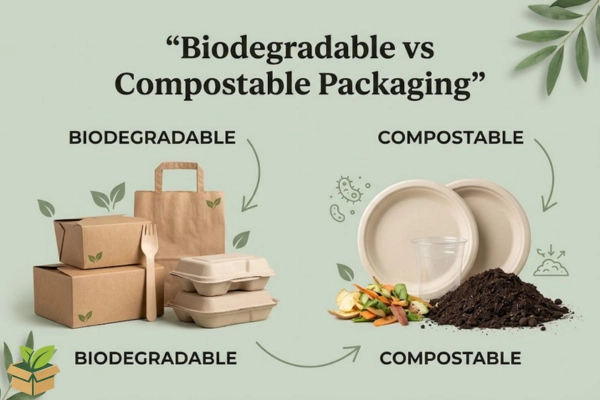
The debate around biodegradable vs compostable packaging often sounds simpler than it is. Both terms suggest that packaging can break down more responsibly than conventional plastic, but they do not mean the same thing. Compostable packaging must decompose under defined conditions and leave compost-compatible material, while biodegradable packaging is a broader category that may not have a guaranteed breakdown time or clearly specified disposal environment.
That distinction matters for consumers, restaurants, cafés, bakeries, and food delivery brands. Choosing a material because it has a green leaf printed on the label is not enough. The packaging must protect the product, suit the available waste system, and provide clear end-of-life disposal instructions.
In this guide, we will explain the difference between biodegradable and compostable packaging, examine common materials, clarify home and industrial composting, and show how businesses can make better packaging decisions without falling into the greenwashing trap.
🌿 What Is Biodegradable Packaging?
Biodegradable packaging is packaging that can be broken down by living organisms such as microorganisms, bacteria, and fungi. During biodegradation, biological activity converts the material into simpler substances. Depending on the material and surrounding conditions, these may include water, carbon dioxide, biomass, and other natural compounds.
The word biodegradable, however, does not automatically tell you how quickly the product will break down or where that process will happen. A biodegradable item might decompose efficiently in warm, moist soil but perform very differently in a dry landfill with limited oxygen and microbial activity.
This is why the term must be supported by context. Temperature, oxygen, moisture, material thickness, microorganisms, and disposal conditions all affect the decomposition process. A package that biodegrades in a controlled test may not disappear quickly when littered beside a road or buried in landfill waste.
Businesses evaluating the subject in a local context can read this detailed guide to biodegradable food packaging in Pakistan, which covers material choices and food-service applications in greater depth.
🍃 Common Biodegradable Packaging Materials
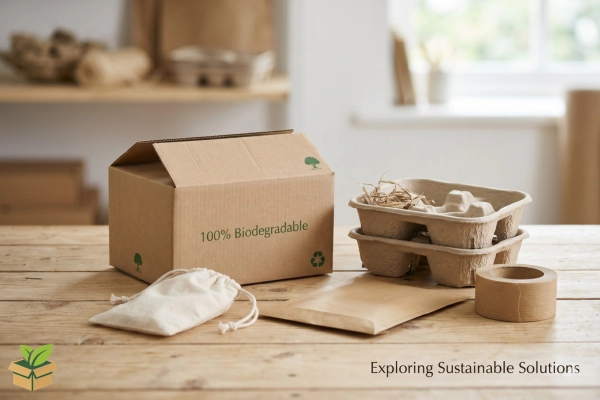
Biodegradable packaging materials may be made from renewable resources, natural fibers, paper, agricultural residue, wood, or specially formulated bio-based plastics. Common examples include kraft paper, molded fiber, cellulose packaging, bagasse packaging, cornstarch-based materials, and certain biopolymers.
Bagasse is the fibrous residue left after sugarcane is processed. It can be molded into plates, bowls, trays, and takeaway containers. Paper and kraft packaging can also biodegrade, although coatings, laminations, adhesives, inks, or plastic windows may change the end-of-life outcome.
Some biodegradable plastics are produced from plant-based sources, but bio-based and biodegradable are not interchangeable. A plastic can be made partly from renewable resources yet remain non-biodegradable. Conversely, some biodegradable polymers may include fossil-derived components. The actual formulation and verified performance matter more than the marketing appearance.
⏳ How Long Does Biodegradable Packaging Take to Break Down?
There is no universal breakdown time for biodegradable packaging. Thin uncoated paper may decompose relatively quickly in favorable conditions, while coated packaging or thicker biodegradable plastics may take considerably longer.
A commercial composting facility, garden compost pile, marine environment, open soil, and landfill are completely different settings. Each provides a different combination of heat, oxygen, moisture, and microorganisms. Consequently, businesses should avoid claims such as “breaks down naturally” unless the claim explains the relevant environment and is supported by credible evidence.
Biodegradable packaging disposal should therefore follow the manufacturer’s instructions. Placing every biodegradable product into a recycling bin or home compost pile can cause contamination or leave material that does not break down as expected.
♻️ What Is Compostable Packaging?
Compostable packaging is designed to biodegrade under composting conditions and turn into compost-compatible material without leaving harmful levels of toxic residue. Unlike the broad term biodegradable, compostability is normally associated with defined test conditions, timeframes, disintegration requirements, and ecotoxicity limits.
In other words, all properly compostable materials are biodegradable, but not all biodegradable materials are compostable. This short sentence captures the central biodegradable and compostable packaging difference.
A compostable item needs an appropriate combination of oxygen, moisture, heat, and microbial activity. When these conditions are available, microorganisms process the material alongside organic matter and food waste. The resulting compost can support soil health when the complete system is managed correctly.
Compostable packaging can be valuable for food service because food-contaminated packaging is often difficult to recycle. If the packaging is certified for the relevant composting route and collected with organic waste, both the food scraps and packaging may enter the same managed stream. That outcome depends on local collection rules and facility acceptance.
🌾 Common Compostable Packaging Materials
Types of compostable packaging include molded bagasse plates, fiber trays, certain cellulose films, certified paper products, and specific compostable plastics. Polylactic acid, commonly known as PLA, is frequently used for transparent cups, lids, linings, and food containers. Polyhydroxyalkanoates, or PHA, represent another family of biodegradable polymers with applications in packaging.
PLA is plant-derived in many applications, but it generally needs carefully controlled conditions to break down effectively. A PLA cup left in an ordinary garden or sent to landfill should not be expected to behave like a dry leaf. The composting environment matters enormously—nature is capable, but it still has operating requirements.
For a practical example, Eco Packaging offers compostable three-compartment biodegradable disposable plates for organized food service, catering, parties, and everyday meals. Buyers should still review the product specifications and applicable disposal guidance before making claims about a particular composting route.
🔎 Biodegradable vs Compostable Packaging: Key Differences
The biggest difference is not simply the raw material. It is the level of definition behind the environmental claim. “Biodegradable” describes a biological breakdown capability, while “compostable” indicates suitability for a composting process under stated conditions.
The comparison below brings the essential points together.
| Factor | Biodegradable Packaging | Compostable Packaging |
|---|---|---|
| Basic meaning | Can be broken down by microorganisms | Biodegrades in specified composting conditions |
| Time requirement | May not have a defined timeframe unless stated | Usually tested against a defined standard and period |
| Disposal setting | Depends on material and verified claim | Home or industrial composting, as specifically certified |
| Final outcome | Varies by material and environment | Designed to disintegrate and become compost-compatible |
| Certification | Claims and standards vary | Often certified under recognized compostability standards |
The practical takeaway from this table is that compostable packaging offers a more specific end-of-life pathway—but only when the correct collection and composting infrastructure exists. A certified industrially compostable cup placed in a general waste bin may still end up in landfill. Good material cannot rescue bad disposal.
Is Biodegradable Packaging Compostable?
Not necessarily. When people ask, “Is biodegradable packaging compostable?” the correct answer is that it must meet relevant compostability criteria before it can be described that way.
A wooden fork, kraft box, biodegradable film, and molded bagasse plate may all break down differently. Their coatings, additives, thicknesses, inks, and manufacturing processes influence performance. Without appropriate testing or certification, biodegradability alone does not prove that a package belongs in a compost bin.
This is also why compostable vs biodegradable packaging should not be treated as a contest in which one label always wins. The best choice depends on product protection, food contact requirements, available disposal routes, local waste management, and verified environmental performance across the packaging lifecycle.
🏠 Home Compostable vs Industrial Compostable Packaging
The word compostable needs one more important detail: where is it compostable? Home composting and industrial composting are not identical systems, and packaging designed for one may not work effectively in the other.
🪴 Home Compostable Packaging
Home compostable packaging is intended to break down in the lower and less consistent temperatures typically found in a household compost pile or bin. These systems are affected by weather, pile size, moisture, aeration, and how frequently the compost is turned.
A genuine home compostable claim should be supported by relevant testing or certification. TÜV Austria’s OK Compost HOME certification is one recognized indicator associated with home-composting conditions. Consumers should follow the product’s instructions because certification may apply to a particular item, thickness, ink, adhesive, or complete packaging format.
Even certified home compostable packaging should not be thrown casually into the natural environment. “Home compostable” does not mean litter-safe, ocean-safe, or guaranteed to disappear anywhere.
🏭 Industrial Compostable Packaging
Industrial compostable packaging is designed for processing in a commercial composting facility. Such facilities can maintain higher temperatures, controlled moisture, regular aeration, and active microbial conditions. This managed environment can process materials that may not break down successfully in a home compost heap.
Common certification standards and references include ASTM D6400 for compostable plastics, ASTM D6868 for items incorporating compostable plastic coatings or additives with paper and other substrates, and EN 13432 for packaging recoverable through composting and biodegradation. BPI certification is widely recognized in North America for products tested against applicable standards.
These labels are useful, but access to composting facilities remains decisive. In many regions, including parts of Pakistan, separate organic collection and industrial composting infrastructure may be limited. A business should confirm what local waste operators accept before advertising industrial compostability as a complete environmental solution.
📦 Practical Packaging Examples
Definitions become more useful when connected to everyday products. Imagine a restaurant serving rice and curry in a molded sugarcane container. If the complete container is certified compostable and a suitable composting service accepts it, food residue and packaging may be processed together. Without that collection route, its theoretical compostability may not be fully realized.
Now consider a kraft takeaway box. The paperboard may be biodegradable, but a conventional plastic lining, glossy lamination, or non-compostable window can alter the product’s disposal route. The package should be assessed as a complete item rather than judged by the brown color of its outer layer.
Businesses seeking practical paper-based formats can explore kraft food packaging boxes and kraft bowls for takeaway meals. Product composition should be checked individually because “kraft,” “paper,” or “natural-looking” does not by itself establish certified compostability.
A café provides another useful example. A paper coffee cup may contain a moisture-resistant lining. Depending on its formulation, that lining could be conventional plastic, a compostable polymer, or another barrier material. The cup, lid, sleeve, and leftover drink may therefore have different disposal requirements.
For restaurants comparing broader options, this overview of eco-friendly food packaging in Pakistan provides a useful starting point. The goal is not to select the product with the greenest name; it is to match performance, material composition, and end-of-life disposal.
🌍 Environmental Benefits and Limitations
The benefits of biodegradable packaging can include lower dependence on persistent conventional plastics, greater use of renewable resources, and reduced long-term packaging waste under suitable conditions. Fiber-based formats may also support plastic-free packaging alternatives for certain food, retail, and delivery applications.
The benefits of compostable packaging are most compelling when the package is difficult to recycle because of food contamination. In a well-managed collection system, compostable food-service packaging can support organic waste diversion and potentially reduce the amount of food waste sent to landfill.
Keeping organic waste out of landfill matters because oxygen-poor landfill conditions can generate methane emissions. Composting, when properly managed, processes organic matter in an oxygen-rich environment. However, the environmental impact still depends on transportation, energy use, feedstock sourcing, manufacturing, collection, processing, and the final use of compost.
Neither label automatically guarantees a low carbon footprint. A heavier package transported over a long distance may have different lifecycle impacts from a lightweight local alternative. Similarly, replacing plastic with paper can increase material use if the product is overdesigned.
For a wider discussion of these trade-offs, read why sustainable food packaging matters. Sustainable packaging is best evaluated as a system rather than a single environmental claim.
🚮 How to Dispose of Each Packaging Type Correctly
Correct disposal determines whether biodegradable or compostable packaging delivers its intended value. Labels should be treated as instructions, not decoration.
Before discarding a package, check the product labeling for the material type, certification mark, disposal instructions, and whether the claim applies to home or industrial composting. Remove conventional plastic parts when the instructions require separation.
A simple disposal check includes:
- Certified home compostable: Place in a managed home compost system according to the instructions.
- Certified industrial compostable: Send only to an accepting commercial composting facility or collection program.
- Recyclable paper or plastic: Keep clean and place in an accepted recycling stream.
- Unverified or mixed-material packaging: Follow local waste guidance rather than assuming it is compostable.
Compostable packaging should not normally go into a recycling bin unless the local recycler explicitly accepts it. Compostable plastics can resemble conventional plastics and may contribute to recycling contamination.
Likewise, recyclable vs biodegradable packaging should not be framed as a simple good-versus-bad choice. Clean, recyclable packaging with an established collection market may have a stronger recovery route than compostable packaging in a city without composting facilities.
Landfill should not be presented as an ideal biodegradation environment. Limited oxygen, moisture, and microbial conditions can slow decomposition, while the environmental benefit of recovered compost is lost. Biodegradable packaging disposal is most effective when the waste system matches the material’s tested pathway.
⚠️ Common Myths and Greenwashing Risks
One common myth is that biodegradable packaging disappears almost immediately. In reality, breakdown time varies widely. A package might require specific temperature and moisture conditions for weeks or months. In an unsuitable environment, the same material may remain present far longer.
Another misconception is that “plant-based” always means compostable. Plant-based packaging describes the origin of some or all raw materials, not necessarily its end-of-life behavior. Bio-based plastics must still be evaluated for biodegradation, compostability, recyclability, and local processing compatibility.
The phrase “eco-friendly packaging” is also broad. Environmentally friendly packaging may prioritize recycled content, renewable materials, reusability, lightweight design, recyclability, biodegradability, or compostability. Responsible claims explain the exact benefit rather than relying on vague green language.
Greenwashing occurs when environmental claims are exaggerated, incomplete, or unsupported. A leaf symbol, earthy color palette, or the word “natural” is not proof. Reliable communication names the material, explains the applicable conditions, identifies certification where relevant, and tells consumers what to do after use.
For foundational context, Eco Packaging’s guide on what eco-friendly packaging means and why it matters explains the broader category beyond biodegradable and compostable products.
🧪 Certification Standards: What Buyers Should Look For
Certification can help a buyer distinguish a tested environmental claim from a vague marketing statement. ASTM D6400, ASTM D6868, and EN 13432 are among the standards frequently connected with industrial compostability. BPI certification and TÜV Austria certification marks can provide additional third-party identification in relevant markets.
Certification must still be read carefully. A logo may apply only to a specific product formulation or manufacturing thickness. A supplier’s raw material certificate does not always establish that the final printed package—with coatings, adhesives, labels, and inks—meets the same requirements.
Business buyers should request current documentation and confirm that the product name or code matches the item being purchased. They should also ask whether the entire package is certified, whether components need to be removed, and which composting route is specified.
This evidence-based approach strengthens EEAT and protects customer trust. Honest limitations are more credible than oversized environmental promises. In sustainable packaging, precision is not boring—it is the part that makes the claim useful.
💼 How Businesses Can Choose the Right Option
The right packaging starts with product performance. A restaurant needs leak resistance, heat tolerance, safe food contact, stackability, and reliable delivery. A bakery may prioritize grease resistance, presentation, ventilation, and protection. Environmental attributes matter, but packaging that fails and causes food waste can create a larger sustainability problem.
Next, map the likely disposal route. Ask whether customers have access to home composting, separate organic collection, commercial composting, or reliable recycling. If the preferred recovery system is unavailable, reconsider the material or provide an alternative collection arrangement.
Businesses should also compare the complete packaging lifecycle. This includes raw materials, manufacturing, transport, storage, product protection, customer use, and end-of-life disposal. The cheapest item per unit may become costly if it leaks, requires double packaging, damages food, or confuses customers.
For companies preparing to make the transition, this guide to switching a business to eco-friendly packaging outlines a practical implementation process. A phased switch often works better than replacing every item at once.
Start with high-volume products where green alternatives can perform reliably. Test them during real deliveries, collect customer feedback, and train employees to explain disposal instructions correctly. After that, expand the program based on measurable results.
Businesses can also review green food packaging options for food brands or browse the broader packaging product range to compare formats for restaurants, cafés, bakeries, and retailers.
🚀 Building a More Responsible Packaging Strategy
A responsible strategy goes beyond replacing a plastic container with a compostable one. It begins by reducing unnecessary packaging, selecting an appropriate size, avoiding redundant layers, and using reusable or recyclable systems where they work well.
Compostable packaging is particularly relevant when packaging is likely to be heavily contaminated with food and when an organic waste collection route exists. Recyclable packaging may be preferable for clean, separable materials with strong local recycling markets. Reusable packaging can offer even greater waste reduction when return rates are high and washing systems are efficient.
Clear communication connects all these choices. Print short disposal instructions on the packaging, train service staff, and explain certification claims on product pages. Avoid telling customers that a package is “100% green” or “harmless to the planet.” Environmental performance is rarely that absolute.
The long-term goal is a circular economy in which resources remain useful for as long as possible and waste is designed out of the system. Biodegradable and compostable packaging can contribute to that vision, but they work best alongside reduction, reuse, recycling, food-waste management, and better public infrastructure.
✅ Conclusion: The Label Is Only the Beginning
The key distinction in biodegradable vs compostable packaging is specificity. Biodegradable packaging can be broken down by microorganisms, but the term may not define a timeframe or disposal environment. Compostable packaging is designed and, when properly certified, tested to decompose under specified composting conditions while meeting requirements for disintegration and compost quality.
That does not make every compostable item the automatic winner. Industrial compostable packaging needs an accepting facility. Home compostable packaging requires a managed compost system. Recyclable packaging needs clean collection and a viable recycling market. Each option succeeds only when the material, application, labeling, and waste infrastructure work together.
For food businesses in Pakistan, the smartest approach is to verify materials, request certification evidence, test performance, and communicate disposal instructions honestly. That combination supports environmental responsibility while protecting food quality, customer trust, and brand reputation.
🌱 Choose Packaging With a Clear End-of-Life Plan
Move beyond vague environmental labels and select packaging that fits both your product and its realistic disposal route. Explore Eco Packaging’s sustainable packaging products for food service, takeaway, bakery, café, catering, and retail applications—and verify the specifications of each product before communicating biodegradability or compostability claims.
❓ Frequently Asked Questions
What is the main difference between biodegradable and compostable packaging?
Biodegradable packaging can be broken down by microorganisms, but the claim may not provide a specific timeframe or disposal environment. Compostable packaging is intended to biodegrade under defined composting conditions and meet requirements concerning disintegration, compost quality, and toxic residue.
Is all biodegradable packaging compostable?
No. Compostable packaging is biodegradable, but biodegradable packaging is not automatically compostable. A product must meet relevant compostability requirements and should carry reliable evidence or certification before being placed in a composting stream.
Can compostable packaging go in a home compost bin?
Only packaging specifically tested or certified as home compostable should be placed in a household compost system. Industrially compostable products may require higher temperatures and controlled conditions that ordinary home compost piles cannot consistently provide.
Can compostable packaging go in the recycling bin?
Usually not. Compostable plastics can contaminate conventional plastic recycling streams because they may look similar but behave differently during processing. Follow local recycling guidance and use a compost collection service that explicitly accepts the product.
Does biodegradable packaging break down in landfill?
It may break down slowly or incompletely because landfill conditions often have limited oxygen, inconsistent moisture, and reduced microbial activity. Landfill disposal can also prevent the material from delivering useful compost or supporting soil health.
Is compostable packaging better than recyclable packaging?
Not in every situation. Compostable packaging may be beneficial for food-contaminated items when composting infrastructure exists. Recyclable packaging may be more appropriate for clean materials with reliable collection and recycling markets. The best option depends on the product and local waste system.
What materials are commonly used in compostable food packaging?
Common materials include bagasse, molded fiber, cellulose, certain paper products, PLA, PHA, and other certified compostable polymers. The final package should be evaluated as a whole because coatings, inks, adhesives, and labels can affect compostability.
How can a business avoid packaging greenwashing?
A business should use specific, evidence-based environmental claims. It should identify the material, state whether compostability is home or industrial, provide relevant certification information, explain disposal instructions, and avoid unsupported phrases such as “completely harmless” or “breaks down anywhere.”















(0) Comments